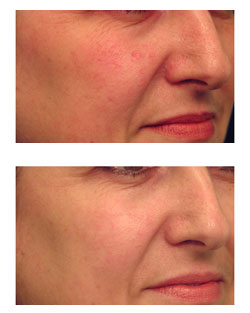
|
Dear Friends Our goal at NYC Dermatology is to be the Tiffanys of Skin Care. I personally see every new patient who visits our office. I am not just
a physician, I am a Board Certified Dermatologist. My goal is, quite simply, to
provide the type of dermatologic care which I would seek for my own family. This is a very important point, since physicans often use the phrase "Doctor's Doctor" to refer to those individuals who typically are selected by physicians themselves
for personal care. I am confident that my practice fully meets that definition. This is the type of 5-star care
and service that our patients expect, deserve and receive. I treat every patient the way I would want to be treated: with
courtesy, dignity and respect. I carefully listen to their skin-care concerns and offer a variety of options including a treatment
plan that I believe will give them the best results and the best dermatologist. We also support our patients with a very fine
medical staff . Please take a moment to explore our top of the line winning website. My philosophy is simple…Experience
Counts and Quality Matters. Please allow me to solve your skin problems. After all,
at NYC Dermatology , our philosophy is if you look great you will feel great with gorgeous skin.” Best Regards, Dr. Rothfeld
Dr. Gary
Rothfeld possesses the special knowledge, skills and professional capability that distinguishes him as an outstanding Dermatologist in
NYC , Manhattan , New York at NYC Dermatology by Board Certified Dermatologist. Top New York City Dermatologist,
Dr. Rothfeld in Manhattan treats the most difficult cases until the problem clears. Dr. Rothfeld, a Board
Certified Dermatologist at NYC Dermatology in Manhattan, New York is caring, detailed, and meticulous and will never
give up until the problem is cleared. Dr. Rothfeld, a board certified dermatologist in nyc who practices Dermatology in
Manhattan, New York has treated many patients in the entertainment and music industry is caring, detailed and meticulous
and will not give up until the condition resolves. Dr. Rothfeld is recognized as one of the best Dermatologists in NYC
by the entertainment industry.NYC Dermatology is
under the medical supervision of Dr. Gary Rothfeld, a Board Certified Dermatologist.
To enhance every aspect of
your skin care, Dr. Rothfeld has personally created a superb line of cosmetic procedures.. NYC
Dermatology by Board Certified Dermatologist Dr. Gary Rothfeld is a board certified NYC Dermatologist
with a New York City office in Manhattan, New York providing expert skin care, dermatology, and
cosmetic dermatology services. A board certified dermatologist in NYC specializing
in dermatology and dermatologic surgery including state-of-the-art cosmetic surgical procedures, Dr. Gary Rothfeld is
known for his attention to body symmetry and his dedication to meeting patients’ personal goals. His specialties include
full body liposuction using the tumescent technique, facial fat transplantation, Botulinum injection into facial lines and
laser resurfacing. NYC dermatology specializes in chemical peels, vein injections, laser, restylane, Perlane,
Botox injections, JUvederm, non-surgical facelifts, collagen implantation and treatment of skin cancer.
As an expert in the field of dermatology and cosmetic dermatologic surgery,
Dr. Rothfeld is has appeared on national television shows. Dr. Rothfeld has also been quoted in many high profile
national magazines.
Our goal at the manhattan office of Board Certified Derrmatologist , Dr. Gary
Rothfeld is to create an atmosphere of professionalism, trust and complete patient satisfaction at the NYC Dermatology
and Cosmetic Surgery Center in Manhattan, New York. Dr. Rothfeld, Dermatology Director of NYC Dermatolgy is a Board
Certified Dermatologist at NYC Dermatology who has treated many patients in the entertainment industry. Schedule an appointment at our office
which provides top of the line expert skin care, dermatology, cosmetic dermatology services, and advanced
dermatology laser treatments for cosmetic needs and medical skin conditions. We offer a full range of services including surgery
for skin cancer, laser hair removal, Botox®, the Fractionated Resurfacing laser, Titan laser, and acne photodynamic treatments.
Our main goal is to provide you with the most effective and advanced treatment. Join the NYC Laser Center NYC Dermatology Mailing
List Our periodic newsletters include exclusive offers, educational articles, as well as free treatment & product drawings!
Email: nycdermatologist@aol.com in our Media office and including different offers and many
more. We offer a variety of services from Botox® to Liposuction . Please contact us with any questions you may have or
schedule an appointment online or by phone for a consultation. Beauty Is Forever! and Dr. Rothfeld
at NYC Dermatologist has over 20 years of experience with his beauty tips.
. During your office consultation and examination you will be provided
with a detailed plan of the treatments that will benefit you most. NYC Laser Center NYC Dermatology top laser dermatology
center offering skin care, dermatolgy,cosmetic dermatology services, and laser treatments for sun damaged skin, acne,
acne scars, rosacea, pigmentation, laser hair removal, broken blood vessels, as well as superficial
and deep wrinkles. We offer patients in Manhattan, services including general dermatology, wrinkle fillers such as Restylane®,
Captique, Perlane,Cosmoderm and Cosmoplast, Radiance® (radiesse)
and Sculptra. We also offer Botox®, Cosmelan, Velasmooth, Fotofacial, Titan laser, Refirme, and
the Fractionated Resurfacing laser. in the treatment of acne, rosacea, skin cancer and surgery. Dr. Rothfeld has
taught numerous other physicians on the proper use of Botox®, medical hair transplants, and lasers in the
country. Acne Photodynamic Treatment - Botox® - Botox® for Hyperhidrosis -
Cellulite - Cool Laser - Cosmelan Depigmentation Treatment - Glycolic Acid Peel - Fat Transfer - Fotofacial / IPL Fractionated
Resurfacing Laser - Hair Loss - Laser Hair Removal - Liposuction - - Surgery - Minimal Scar Technique - Photodynamic
Rejuvenation Radiance® - Restylane® - Sclerotherapy - Sculptra - Smoothbeam - Stretch Marks - SunFX - TCA Peel - Tattoo
Removal - Titan Laser Facelift - V-beam Laser Treatments - Velasmooth Our cosmetic surgeon includes Dermatologist Dr.
Gary Rothfeld Board Certified Dermatologist at NYC Dermatology. Our NYC dermatologist
offers advanced dermatology laser treatments for cosmetic needs and medical skin conditions. We offer our services to
Manhattan , Brooklyn, Bronx, Queens locations through our Manhattan office in NYC
Sun ProtectionUltraviolet radiation is the major
cause of skin cancer, including melanoma. It is important for everyone to be aware of its damaging effects and take measures
to avoid overexposure. Although many people enjoy the appearance of tanned skin and think it looks "healthy,"
tanned skin is damaged skin. The ultraviolet radiation in sunlight penetrates the deepest layers of the skin where it harms
the cells. The body responds by making more pigment (melanin) to try to protect itself, but the damage has already happened
and may be permanent. The more exposure you have to the sun, the more likely you are to develop skin problems later in life. Ultraviolet
RadiationThe damaging part of sunlight is called ultraviolet radiation, or UV rays. It is categorized into three types: - UVC
rays (wavelengths = 200 nm to 290 nm) are the shortest and most powerful of the UV rays. UVC is the most likely
to cause cancer if it reaches skin. Fortunately, most of it is absorbed by the ozone layer in our atmosphere. However, there
is concern that a thinning of the ozone layer may be causing more UVC to reach the earth's surface.
- UVB rays (wavelengths
= 290 nm to 320 nm) are less damaging than UVC, but more of it penetrates to the earth's surface. It is the most common cause
of sunburn and skin cancer. UVB is particularly strong at the equator, at high elevations, and during the summer.
- UVA
rays (wavelengths = 320 nm to 400 nm) are the least powerful of the UV rays, but they are present all year and
can penetrate windows and clouds.
Sun ProtectionThe first and more effective way to avoid sun damage
is to stay out of tthe sun as much as possible. If you cannot avoid being exposed to sunlight, there are five basic
defenses that you should keep in mind when you go outdoors: - Avoid peak hours of sunlight
- Sunscreen
- Clothing
- Sunglasses
- Shade
Avoid
Peak Hours of Sunlight (UV Index)In general, UV rays are the greatest between 10 a.m. and 4 p.m. It is best to avoid
the outdoors during these hours without protection, particularly during summer, in tropical regions, or at altitude. During
this time, you should pay close attention to the appropriate use of sunscreen, clothing, sunglasses, and shade. You
can obtain an accurate measure of the amount of UV rays in your area by looking up the Ultraviolet (UV) Index. The
UV Index is like a weather forecast. It provides a report on the amount of damaging UV rays that are expected to affect a
region on a particular day. The UV Index changes day to day according to time of year, cloud cover, atmospheric ozone, and
other factors. The following table is a breakdown of the UV Index. A high UV Index number means that you are at greater
risk of being exposed to ultraviolet radiation. You should take special care to avoid outdoor exposure to sunlight when the
UV Index is moderate or greater. - 0 to 2 = Minimal
- 3 to 4 = Low
- 5 to 6 = Moderate
- 7 to 9
= High
- 10 or more = Very high
The UV Index can be found on our Website or in local papers, usually in
the weather section. SunscreenThere are several factors to consider when selecting the right sunscreen. (See
the Sunscreens handout for more information.) Sun protection actor (SPF) - Sunscreens are rated
by the amount of protection they provide from UVB, measured as the "sun protection factor" or SPF. Sunscreens with
higher SPF provide greater protection from the sun. It is best to use sunscreens that offer a minimum SPF of 15. Broad-spectrum
sunscreens - It is best to use a sunscreen that can protect you from both UVA and UVB rays. These are called
"broad-spectrum" sunscreens.
Most of the original sunscreens blocked only UVB, but increased awareness
of the damage caused by UVA has lead to the development of ingredients that protect against UVA too. Broad-spectrum sunscreens
combine ingredients to provide a product with greater protection. Common sunscreen ingredients that provide protection
from UVB rays: - Cinnamates
- Octocrylene
- PABA (para-aminobenzoic acid)
- Padimate O and Padimate
A (Octyl Dimethyl PABA)
- Salicylates
Common sunscreen ingredients that provide protection from UVA
rays: - Avobenzone (Parsol 1789)
- Benzophenones (oxybenzone, dioxybenzone, sulisobenzone)
Sunblocks -
"Physical" sunscreen ingredients lie on top of the skin and work by reflecting or scattering UV radiation. They
are particularly useful for people who are sensitive to the ingredients found in other sunscreens. Sunblocks often contain
one or more of these ingredients: - Zinc oxide
- Titanium dioxide
- Iron oxide
Although past
formulations were unsightly (often leaving a white film on the skin), newer "microfine" formulations are invisible
after being applied. Microfine titanium dioxide is effective at protecting from both UVA and UVB rays. Water
resistance - Sunscreens are classified as "water-resistant" if they maintain their protection after
two 20-minute immersions in water. They are classified as "waterproof" if they maintain their protection after four
20-minute immersions. You should seek a water-resistant or waterproof sunscreen if you will be participating in water sports,
such as swimming or water skiing, or will be actively sweating. However, independent testing has shown many products
do not perform well in the real world. So it remains a good idea to apply sunscreen every time you leave the water, or frequently
if you are actively sweating. Using a SunscreenSunscreen should be applied evenly and liberally on all sun-exposed
skin within 30 minutes before going outside to give sunscreen time to take effect. (Sunblocks are effective immediately after
being applied.) Sunscreens should be reapplied every two hours or following swimming or sweating. Apply sunscreen generously
and reapply frequently at least every two hours.
The chemicals may lose effectiveness over time, so it is important
to throw away sunscreen that is past its expiration date or is over two years old.
No sunscreen is 100% effective;
take additional measures to avoid the damaging effects of the sun's rays.
ClothingClothing can provide excellent
protection from the sun. However, not all clothing is protective. A thin, wet, white t-shirt will provide almost no protection
from UV rays. When selecting clothes for sun protection, consider the following: - Cover your head, shoulders, arms,
legs, and feet.
- Use a hat that is broad-brimmed (brim should be at least four inches wide).
- Wear fabrics that
are thicker or with a tight weave; these allow less sunlight to penetrate the skin.
- Wear darker-colored clothes that
absorb more UV rays.
- Wear clothing made from nylon or Dacron because it is more protective than cotton.
- Avoid
remaining in wet clothes because wet fabric may allow more UV rays to penetrate the skin.
- Wash clothing with chemical
absorbers to increase their protectiveness.
- Some clothing comes with a UPF rating that stands for "Ultraviolet
Protection Factor." This measures the ability of the fabric to block UV radiation from penetrating to the skin. A fabric
with a UPF 15 allows only 1/15th (6.66%) of the UV radiation to penetrate your skin as compared to uncovered skin.
Garments
fall into 3 categories: - Good protection: UPF = 15 to 24
- Very good protection: UPF = 25 to 39
- Excellent
protection: UPF = 40 to 50+
Choose clothing with a UPF rating of at least 15. Keep in mind that the UPF of a garment
will decrease over time as the fabric wears. SunglassesOverexposure to sunlight can cause cataracts and macular
degeneration, a major cause of blindness. Sunglasses can provide protection. However, not all sunglasses are of value. A darker
lens itself does not guarantee protection. Look at the label to ensure that the glasses provide UV protection. Sunglasses
should be large enough to shield your eyes from many angles. Look for sunglasses that are described as blocking 99% or 100%
of UVA and UVB. The glasses may also be described as providing UV absorption up to 400 nm. ShadeIf possible,
remain in the shade when outdoors. Keep in mind that shade does not provide full protection from the sun because UV rays can
bounce off reflective surfaces, such as sand, snow, water, concrete, or even porch decks. In addition, some fabrics used as
shade devices, such as parasols or umbrellas, may not provide sufficient protection. If you seek shade under a cloth, look
for a fabric that is thick, tightly woven, and dark-colored. Clear window glass provides protection from UVC and UVB,
but not UVA rays. If you are frequently exposed to sunlight while driving, the plastic interleaf of your windshield (which
prevents it from shattering) can help block the light, but side windows have no such protection. Non-drivers can make use
of additional window shade devices. Drivers in some states may be able to use darkly-tinted glass in the side windows, but
this is illegal in some states. Summary- Avoid the sun when its UV rays are strongest,
between 10 a.m. and 4 p.m.
- Use a broad-spectrum sunscreen with SPF 15 or greater. Apply it 30 minutes prior to being
exposed to the sun and reapply every two hours. Consider using a water-resistant sunscreen if you will be active (sweating)
or in the water.
- Use a sunblock on your lips.
- Wear a broad-brimmed hat when outdoors.
- Wear sunglasses.
- Wear
tightly woven, dark clothing to cover your arms, legs, and feet.
- Stay in the shade when possible.
- Avoid reflective
surfaces, such as water or snow.
- Avoid sunbathing.
- Don't be fooled by cloudy days since damaging rays can
penetrate clouds.
What's new
Site map
Site map
Site map
Site map
Site map
Site map
Site map
Site map
Site map
Site map
Site map
Site map
Site map
Site map
Site map
Site map
Site map
Site map
What's new
What's new
Site map
Site map
Site map
Site map
Site map
Site map
Site map
Site map
Site map
Site map
Site map
Site map
|